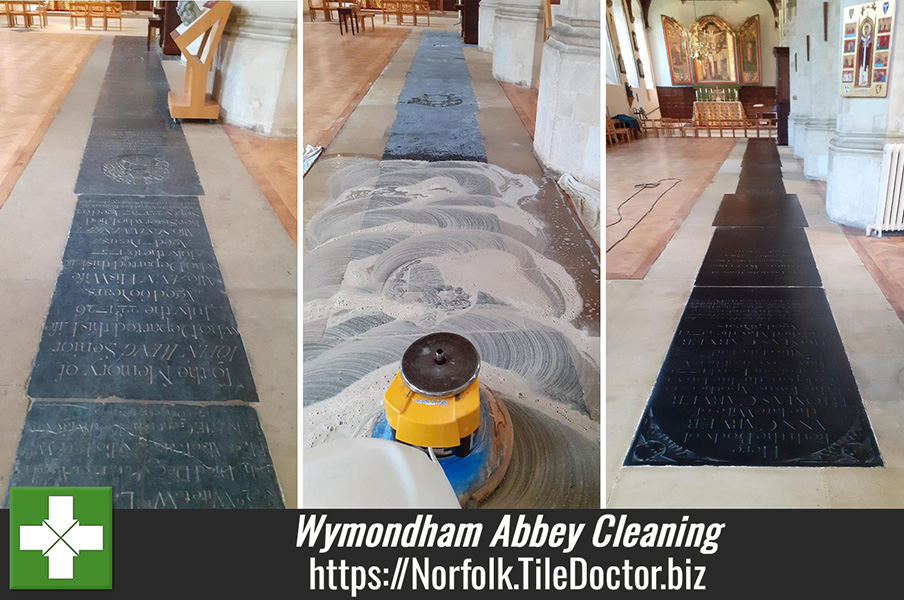
Using Tile Doctor Stone Oil to Restore the Colour to Black Marble Ledger Stones at Wymondham Abbey
I am proud to have been asked to renovate the Sandstone floor at Wymondham Abbey which is one of the grandest religious buildings in East Anglia. The floor consisted of an entrance area of very dirty and dull honed sandstone flags leading to an aisle of sandstone and dull, scratched black inscribed Marble ledger stones totalling approx. 200m2.

The abbey is a magnificent Norman church, originally established in 1107 as part of a monastic foundation. It was later enlarged and embellished with a particularly fine angel roof and the unusual twin towers are a prominent local landmark.
Having been asked to quote for the renovation of the floor and given its age I decided it would be best to visit the property and survey the areas needing attention before quoting. The flooring was in good physical condition and everything was as described; I could see the stone would need a deep clean burnishing and detail work needed around the engravings. I worked out a plan for the renovation which was considerate of the abbey’s age and from that prepared a detailed quote which was accepted.
Stripping and Deep Cleaning an Indian Sandstone Tiled Kitchen Floor
To start Tile Doctor Pro-Clean (diluted with three parts water) was applied to all surfaces and left to soak in for ten minutes before being scrubbed using a heavy 40kg Klindex rotary floor machine. For extra traction, an additional 10kg of weight was added and the machine was fitted with a 120-grit silicon carbide brush. This combination releases the soils from the stone to the surface where it was extracted using a Klindex triple-vac. It certainly helps having the right machinery for this type of work.

The deep engravings on the Marble ledger stones were hand cleaned with Tile Doctor Oxy-Gel and a grout brush and then finished with 400 and 800-grit diamond pads fitted to the rotary. These pads work wonders on hard stone surfaces such as Marble. The soiling was extracted as work progressed and after a final rinse the floor was left to dry off overnight.
Sealing an Indian Sandstone Tiled Kitchen
Next day the Marble ledger stones were checked for moisture to confirm they were dry before applying a coat of Tile Doctor Stone Oil. This works well on dark stone as the oil deepen the dark colours.

Once dry the whole floor was sealed with two coats of Tile Doctor Colour Grow which is a colour enhancing impregnating sealer that brings the features in the stone alive. Once dry the Marble ledgers were given a buff using a hand-held rotary polisher fitted with a white buffing pad.
 |  |
The Committee members were exceptionally pleased with the results achieved and have asked us to return to work on the next section of floor as part of their ongoing renovation schedule.
For aftercare I recommended the use of Tile Doctor Neutral Tile Cleaner which is a gentle yet effective cleaner that won’t impact the sealer. Strong bleach-based cleaners need to be avoided as they will strip the sealer off the stone prematurely.
Source: Stone Cleaning and Restoration Products and Services in Wymondham Norfolk